1.1 SCHOOL PROFILE
School Grounds of SMAN 10 Padang
Sekolah menengah Atas negeri 10 padang
A. Vision Formulation
“Faithful, Academic, and Non-Academic Excellence, Environment and Culture Compete Globally.”
B. Formulation of the Mission and Objectives of the Educational Unit
- Creating graduates who are able to perform worship according to religious demands.
- Produce graduates who behave admirably so that they can be imitated and followed by others.
- Form students who behave politely, and care for parents, teachers, and others.
- Delivering students to improve learning achievement according to school standards and compete to get favorite universities at home or abroad.
- Distributing talents and interests of students according to their potential .
- Realizing graduates who have community service and care for the environment.
- Equip students to become young researchers by utilizing natural resources as one of the media in research.
- Equip students with knowledge on how to use used goods to be selling points.
- Creating students who are able to communicate in public activities both in Indonesian, English, or other foreign languages.
- Developing knowledge and skills in the field of study that is applied with mastery of Technology, Information and Communication by building networks between domestic and foreign students.
C. School Purpose
- Realization of competency-based testing curricula and systems in an effort to achieve an average UAN score of above 8.5 for each subject and be accepted at a public university with accreditation of A 98%.
- Implementation of a selection system for independent new students. Valid and objective.
- Increased competence and qualifications of teaching staff, more than 40 % with S 2 qualifications and competent in their respective fields in accordance with the demands of a quality learning program.
- Increased ability of education staff to organize education administration professionally in accordance with their respective duties and functions.
- Meeting the needs of representative school facilities and infrastructure with the number and quality according to national standards. With an emphasis on international and IT-based infrastructure.
- Establishment of cooperation with institutions related to society and the business world/ industrial world in the context of developing educational programs that are rooted in national culture and follow the development of Science and Technology.
- The creation of PBM that leads to IT-based and Innovative Learning programs.
- Increased implementation of multiple student intelligence development programs (IQ, EQ, and SQ) which are manifested in extra-curricular activities and self-development.
- Applied KTSP by teachers in PBM, so that students are able to achieve competency standards above 80%.
- . Establishment of cooperation with institutions related to society and the business world / industrial world in the context of developing educational programs that are rooted in national culture and follow the development of science and technology.
- Realization of Padang N 10 High School in 2010 to become a center of excellence in the field of services, out came and the involvement of parents and stakeholders in school development.
- Establishment of as safe, comfortable, shady and environmentally sound school environment.
- Implementation of school culture with 5S culture (Sholat, Sapa, Smile, Greetings, and Courtesy).
- The realization of the commitment of the environmentally friendly and socially friendly school to the development and expansion of school access in improving the quality of education.
1.2 ACADEMIC SUPPORT SYSTEM
D Classroom Building
Sekolah Menengah Atas Negeri 10 Padang has several classes offered particularly to senior high school students. This school accepts students from Grade 10 to Grade 12. Academically, this school is one of the most entrusted senior high school in Padang. Due to the fact that, it has the needed support system to provide quality education to students. SMAN 10 has a designed school classrooms that can accommodate enough number of students. This school has 4 buildings named as A, B, C, D buildings for students. Each three-storey building has numerous classrooms that are well-ventilated and lighted.
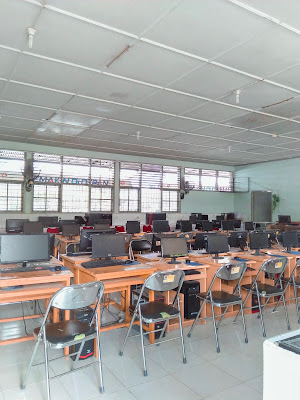
For other school facilities like library, students have an access to borrow books and do their school works inside. Various textual information can be found inside the library such as academic books, encyclopedia, dictionaries, research papers, and student journals. Computer laboratory is also readily available for teachers and students. Teachers can utilize computer as source of information for making their teaching plan. On the other hand, students are allowed to use the computer for making their assignments and paper works. Faculty room can be found in the ground floor where teachers stay for their leisure time. Also in the ground floor, various buildings can be found such as infirmary, mosque, comfort rooms, and canteen.
There are also laboratories for chemistry, physics and biology which are really vital for students who took Matematika dan Ilmu Pengetahuan Alam (Mathematics and Natural Science) as their field of specialization. Inside the laboratories are complete set of equipment needed for conducting experiment, research and study.
Normally, the school classes always start from Monday to Saturday. Everyday, classes start at 6:45 in the morning until 3:00 in the afternoon. Although during Saturday class, it starts at 6:45 in the morning and only until 12:00 noon. During Mondays, they conduct a flag ceremony and announcements that consume an hour.
Each subject has particular allotted time that is different from other subjects. Also, every grade level has varying class time frame. For grade 12 students, they are given more time for intricate wrap up discussion compared to grade 10 and 11 students who are then exposed to many group activities and individual activity worksheets.
Class breaks are also given to students for them to have a rest from a long discussion and also for them to eat some food. From Monday to Friday, they have a snack break at 10:00 to 10:30 and a separate break for lunch and prayer time at 12:00 to 12:30 in the afternoon.
Here, the two fundamental strands are MIPA (Matematika dan Ilmu Pengetauhan Alam) and IPS (Ilmu Pengetahuan Sosial). The school curriculum focuses on these two specializations. Each strand caters different subject that will develop their skills on their chosen specialization. In Matematika dan Ilmu Pengetauhan Alam (MIPA), different field of science and mathematics are establish to develop student’s proficiency in the subject Mathermatics and Natural Sciences like Chemistry, Biology, and Physics. Mostly, Bahasa is the medium of instruction although students are good in speaking English language.
1.4 MATERIALS AND OTHER LEARNING RESOURCES
School Library
In SMAN 10, teaching and learning process takes place smoothly due to the fact that there are enough teaching materials and learning resources within the school campus. Lesson planning is a crucial process of organizing the structure of learning. For teachers, constructing attainable learning outcomes is a must. In order to achieve that, teaching materials are essential like book references, internet resources, and instructional materials.
Fortunately, SMAN 10 teachers are fully equipped with necessary teaching materials to support their planned lesson. On the other hand, students are provided with learning books for one school year. These individual learning books will be their guide throughout the whole year of class. Aside from books, teachers also provide learning modules for additional source of information. Worksheets are also given to students as their learning activity and as a form of assessment. Aside from textual books, resource centers are also present in the school campus.
Air conditioned library is readily available for all students and teachers. They can borrow various books and even work inside the library. Another is the computer laboratory where both students and faculty teachers have an access to surf the internet and do their paperwork in there. Inside the classroom, multimedia tools are provided that makes teaching and learning effective and with integration of educational technology.
1.5 MEASUREMENT AND EVALUATION
The school measures student’s learning through authentic assessment. I have learned that authentic assessment is a tool that can be used to measure if the students attained the learning outcomes in which higher-order thinking skills are conditioned. Comparably, this kind of assessment involve real-world tasks in appropriate learning context. In one semester, midterm and final examinations are given to students to assess their learning and test their competencies. Daily quizzes can also be an option of other teachers as means of evaluating student’s understanding of the finished topic.
In the lesson plan, there appears the assessment criteria especially designed for the three domains of learning; behavioral, psychomotor and cognitive aspects. Every domain has separate assessment rubric and format. In curriculum 2013, affective aspect of students are given much attention compared to previous curriculum. Consequently, there is what they called ‘attitude assessment’ where teachers must be keen observant of student’s actions and behavior inside the room. According to most of the teachers in SMAN 10, if students have high marks on cognitive aspect and low marks on affective aspect, there is a great possibility that the student will not proceed to another semester. It is because teachers have minimum completeness criteria. If students reached the set value, enrichment is held and for students who failed, they have to take a remedial class.
Indonesia uses Curriculum 2013 where it provides a student-centered classroom and change in teaching style. As what I have noticed from my cooperating teacher's type of teaching is that she does not spoon feed students instead facilitates their learning through inquiry based instructions. In this curriculum it encourages students to be more active and use their critical thinking as well as communication skills in the learning process.
Their curriculum also contains the three domains of learning which are the cognitive, psycho motor and affective aspect. Furthermore, it establish a kind of competency based education where students are expected to develop necessary 21st century skills through out the learning process.
This curriculum is highly utilized in making teaching plan as they based their learning competencies and procedures in the governing general curriculum. Therein the teaching plan are the learning activities, procedures, resources, assessment and rubrics.
1.7 TEACHING PLAN
During my first visit in SMAN 10, I politely asked questions on how they make a teaching plan. According to my coordinating teacher, in making the teaching plan they should always base the learning competencies based on the general competencies written in the established curriculum in Indonesia. The content of their teaching plan always depend on the existing curriculum.
I was able to scan through the teaching plan handed to my by my cooperating teacher but it was written in Bahasa. They use their native language in making teaching plan as compared to Philippines, if it is a subject that uses Filipino language as medium of instruction then it should be written in Filipino and so with other subjects which use English as medium of instruction.
Their teaching plan is well-organized and constructed. One can see the detailed plans of the teacher for her instruction. The learning competencies are given emphasis as manifested in their curriculum.
Sample Lesson Plan in Biology